Pay attention, attention to details.

Pay attention, attention to details.
So I asked ChatGPT how would Miyamoto Musashi live his life if he were living today and was in my position and here’s the output.
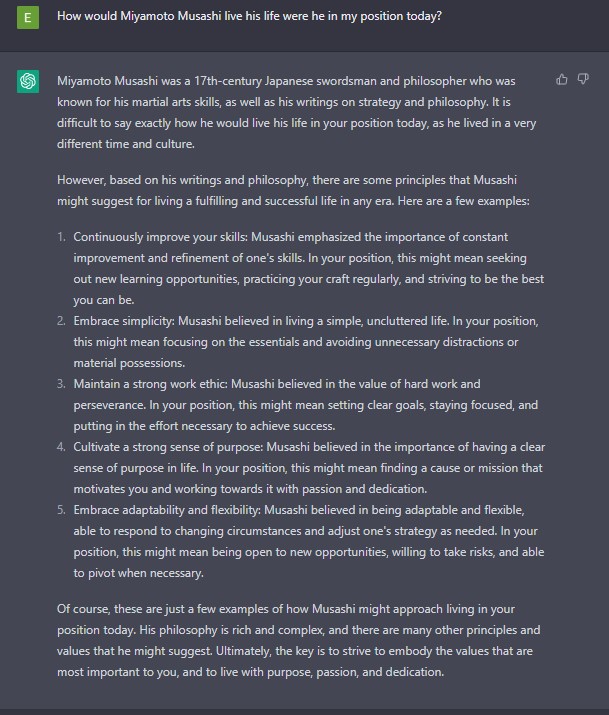
This response might sound generic and corny but it’s a testament to Musashi’s profound knowledge of the human psyche and mindset. In life there’re circumstances outside of your control, people don’t treat you well, your plan doesn’t pan out as desired, people or companies take advantage of you, and so forth but resentment is not an answer. Instead, be adaptable and pivot navigating the unpredictable circumstances of life while keep learning and maintaining your work ethic. Life is like an experiment, and the worst outcome of an experiment is failing to learn from the said experiment.
How long will you wait before you demand the best of yourself, and trust reason to determine what is best? You have been introduced to the essential doctrines, and claim to understand them. So what kind of teacher are you waiting for that you delay putting these principles into practice until he comes? You are a grown man already, not a child any more. If you remain careless and lazy, making excuse after excuse, fixing one day after another when you will take yourself in hand, your lack of progress will go unnoticed, and in the end you will have lived and died unenlightened.
Finally decide that you are an adult who is going to devote the rest of your life to making progress. Abide by what seems best as if it were an inviolable law. When faced with anything painful or pleasurable, anything bringing glory or disrepute, realize that the crisis is now, that the Olympics have started, and waiting is no longer an option; that the chance for progress, to keep or lose, turns on the events of a single day. That is how Socrates got to be the person he was, by depending on reason to meet his every challenge. You are not yet Socrates, but you can still live as if you want to be him
Some high-level points from the book Relentless by Tim Grover.
When you’re a Cleaner…
#1. You keep pushing yourself harder when everyone else has had enough.
#1. You get into the Zone, you shut out everything else, and control the uncontrollable.
#1. You know exactly who you are.
#1. You have a dark side that refuses to be taught to be good.
#1. You’re not intimidated by pressure; you thrive on it.
#1. When everyone is hitting the “In Case of Emergency” button, they’re all looking for you.
#1. You don’t compete with anyone; you find your opponent’s weakness and you attack.
#1. You make decisions, not suggestions; you know the answer while everyone else is still asking questions.
#1. You don’t have to love the work, but you’re addicted to the results.
#1. You’d rather be feared than liked.
#1. You trust very few people, and those you trust better never let you down.
#1. You don’t recognize failure; you know there’s more than one way to get what you want.
#1. You don’t celebrate your achievements because you always want more.
An interesting article (from people at Bain & Co.) on the rule of thumb approach which is being used to evaluate the value and performance of the SaaS companies based on growth rate (%) and growth margin (%).
In a nutshell, a quick way to gauge the performance and the value of the SaaS company is to look into growth rate (%) and growth margin (%) and if the combined value exceeds 40% then it’s a quick but good indicator of the company’s performance.
The article also touches upon several important points such as ways to beat the Rule of 40 and ways to increase the efficiency and effectiveness of a maturing business.
Some highlights:
“The Rule of 40 – the principle that a software company’s combined growth rate and profit margin should exceed 40% – has gained momentum as a high-level gauge of performance for software businesses in recent years, especially in the realms of venture capital and growth equity.“
“The metric neatly captures the fundamental trade-off between investing in growth (including new products and customer acquisition) and short-term profitability. Analysts have differed on which measure of profitability to use—most use EBITDA, but some have proposed free cash flow, EBIT, or net income as alternatives. We use EBITDA, a publicly available profitability metric that excludes the effect of taxes and accounting policies.”
Future of work research by McKinsey. A good summary which skills are here to stay https://www.mckinsey.com/industries/public-and-social-sector/our-insights/defining-the-skills-citizens-will-need-in-the-future-world-of-work#
The path of least resistance is rarely the path of wisdom. Do what’s right.
You should own your own risks.
Don’t do to others what you wouldn’t want them to do to you.
You’ve got to act, take action! You’ve got to be willing to fail. Take action.
You got to figure out where the growth areas are, then you got to focus on those growth areas. It doesn’t matter how clever you are, if you’re pushing on a closed door it’s much more difficult.
 ieraj.blog